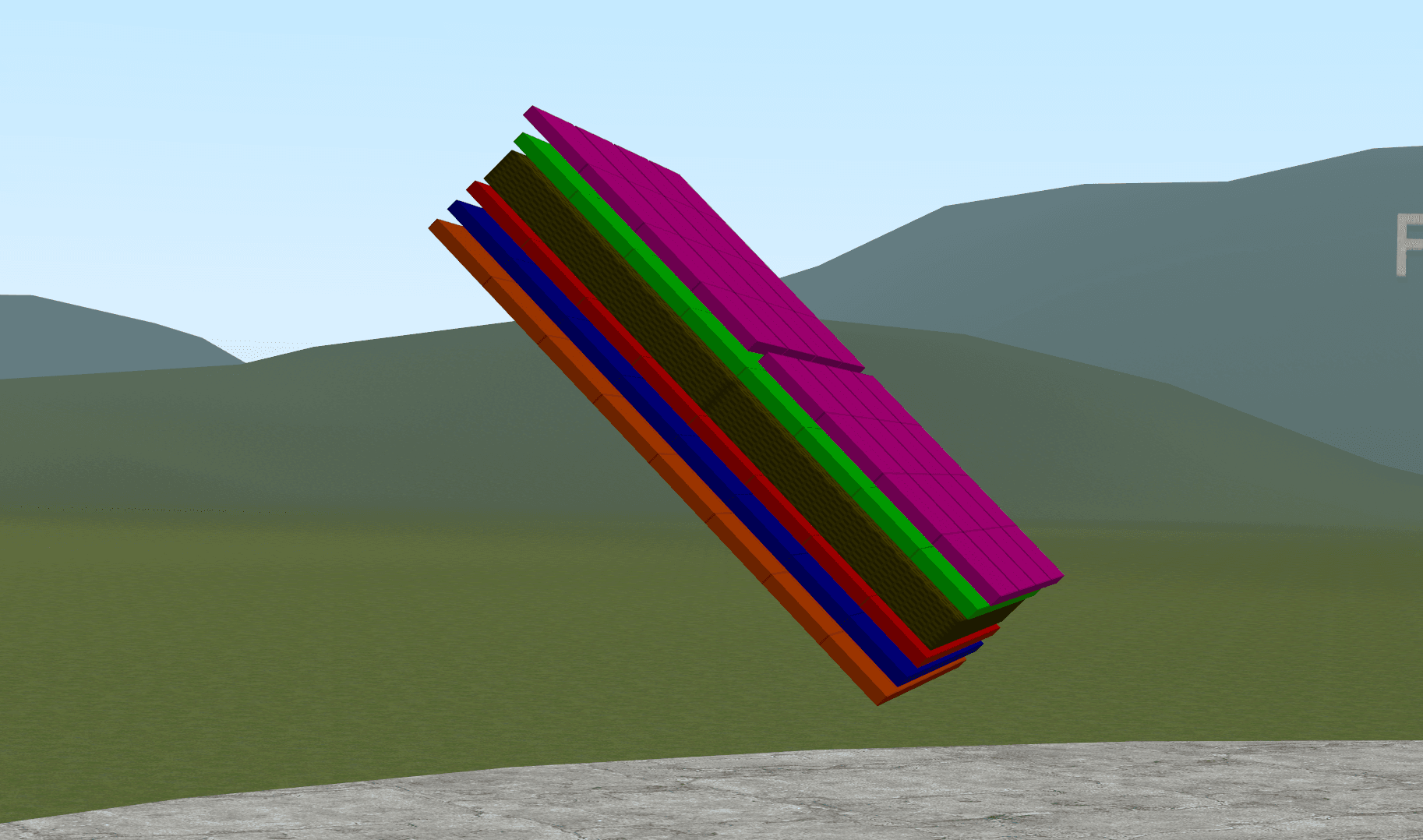
Material Types
ACF always had RHA as its armor material for each part of a tank, meaning limited mechanics with some round types like HEAT, or making some fake composite armor just adjusting its health. ACE instead, brings you another 5 different types of materials that will bring you some benefits with them. This page will talk about materials that ace uses.
Updated, same as the latest version. To change the material, go to the "Armor Properties" tool and choose the desired material in a box called "Material"
But before proceeding... the glossary Type
Description
Year
The year
Curve
Defines how effective is increasing the armor thickness. Any value below 1 means loss
Mass Multipler
A multipler for Mass. RHA scaled
KE Protection
How many times is good vs Kinetic Penetrators. RHA scaled
CE Protection
How many times is good vs Shaped charges. RHA scaled
Aluminium Aluminum is normally used by AFVs or light constructions, as it provides significantly more protection for a given weight. It is more costly and prone to spalling though.
Year
Curve
Mass Multipler
KE Protection
CE Protection
1955
0.92
0.333x RHA
0.8325x RHA
0.8325x RHA
Cast Homogeneous Armor (CHA) Despite of being heavier than RHA, Cast steel material provides more resiliance against damage than its rolled counterpart. Highly vulnerable to spalling.
Year
Curve
Mass Multipler
KE Protection
CE Protection
1930
1
1.25x RHA
0.98x RHA
0.98x RHA
Ceramic Ceramic is usually used as a material to ensure shells do not penetrate due to its high penetration resistance. Due to its frailty it is usually only used as a backing and is not meant to take the brunt of damage. Do not let it get penetrated or it will shatter.
Year
Curve
Mass Multipler
KE Protection
CE Protection
1955
0.99
1.2x RHA
2.05x RHA
2.05x RHA
Depleted Uranium (DU) Heavy yet extremely effective armor. Though costly, a slab of this can stop just about anything. But it causes blast damage when penetrated.
Year
Curve
Mass Multipler
KE Protection
CE Protection
1970
1.06
2.43x RHA
3x RHA
3x RHA
Explosive Reactive Armor (ERA) An explosive composite sandwiched between 2 plates. When penetrated the plate detonates damaging or even destroying the incoming shell degrading its performance. This material is heavy compared to RHA and unlike other materials, will damage anything near the detonation. Explosive rounds can make short work of this material.
Year
Curve
Mass Multipler
KE Protection
CE Protection
1955
0.95
2x RHA
3x RHA
10x RHA
Rolled Homogeneous Armor (RHA) Simple, generic, but trusty steel. The standard armor everything else is compared to.
Year
Curve
Mass Multipler
KE Protection
CE Protection
1900
1
1x RHA
1x RHA
1x RHA
Rubber Another material that while useless against kinetic rounds, excels at stopping shaped charges and spall.
Year
Curve
Mass Multipler
KE Protection
CE Protection
1955
0.93
0.2x RHA
0.05 RHA
3x RHA
Textolite Fiberglass based material, this material provides decent protection against both chemical especially and kinetic rounds, while taking reduced damage from explosions.
Year
Curve
Mass Multipler
KE Protection
CE Protection
1955
0.94
0.35x RHA
0.5x RHA
1.2x RHA
Titanium Lightweight and super resiliant. But EXPENSIVE. 60% Lighter than RHA for a given thickness.
Year
Curve
Mass Multipler
KE Protection
CE Protection
1950
1
0.61x RHA
1.7x RHA
1.7x RHA