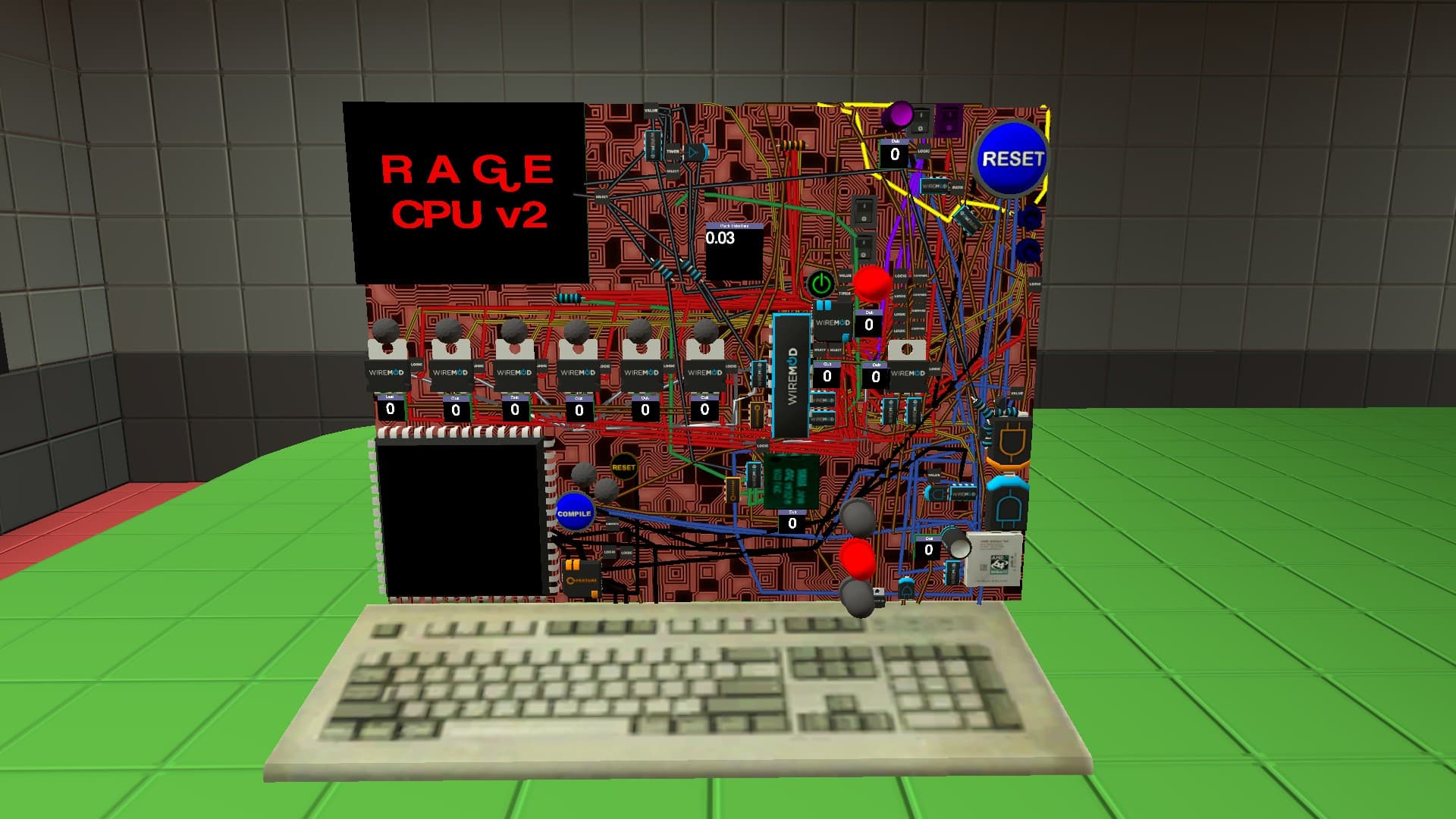

RAGE CPU v2-Built Entirely from Gates And FPGA Features:
- 8 Bit ALU With Latch
- 6 Registers+Temporary Register(Accumulator Design)
- Bus With Latch
- Custom Assembly Language
- Console With Color Commands
- 8kb EEPROM
- 64bytes of Opcode & Operand RAM
- 16 bit wide Instruction Set With One 4 bit Decoder
- 33Hz Clock
- Conditional Jumping(Branching)!!!
- EEPROM Programmer included in Download
1.Introduction:
- I've always wanted to make a cpu in the past but never had the knowledge to do it and i still don't since this is NOT a fully realistic design. It took me a month to make this beast.
- You can write programs on it with my own custom assembly language as well as program the EEPROM.
- You can also learn how a real cpu works with this, even though this isn't FULLY realistic.
- Keep in mind, this cpu is NOT 16-Bit,8-Bit,4-Bit.It does not have any limits and if it did they would be set by me since this is NOT a fully realistic design.
2.Architecture: Back View Front View
- The architecture consists of FPGA Chips,Selection,Comparison,Logic and even Arithmetic Gates.
- The motherboard contains 137 gates and chips, while all the components contain 530 gates. That's 667 Gates TOTAL!
- All other chips and gates that are not mentioned in the picture are usually just gates and FPGA chips that make the whole thing work and talk between components. They are CRUCIAL for this machine to function.
3.Component Architecture: Control Unit:76 Gates Assembler:342 Gates Console Chip:81 Gates Arithmetic And Logic Unit:31 Gates
- This totals to exactly 530 gates just in the main components.
4.Assembling Instructions:
- Currently, it only contains 35 instructions which are listed in the manual that comes with the download.
- The assembler reads from your input and searches the database to see if the command exists and matches your input. If it does, a indicator will turn green to let you know. When you press CTRL, another indicator will turn blue and then it compiles the code to a number which the control unit reads, sends it to opcode memory and increments the opcode counter.
- When you press the "StartProgram" button, it will cycle through Opcode, Operand and Jump Address Memory while the control unit reads the instructions and executes them all on the same cycle.
This program will count to 10 and then back to 1 This computes Fibonacci infinitely 5.EEPROM Programmer: Writing 65536 to address 6 of the EEPROM EEPROM Programmer:89 Gates
- The manual for using this is also in the download files. Its WAAAY to complicated to explain here.
6.Development:
- This actually started of as just an arithmetic logic unit while i was still learning how a cpu works.
My First ALU!
- A month ago,i built the alpha version on the Rage cpu. It barely worked but hey, it proved that something bigger was possible.
Alpha Version This was seriously a lot of work but i loved it. Every second of it. And i hope someone else likes it and please, ask any questions you might have and report ANY bugs since i'm sure there's many.
Discussion (0)
Join the conversation to ask questions or share your thoughts.